
Road safety products for distributors, contractors and government projects
WhatsApp: 008618662728327Language:
 English
Road safety products for distributors, contractors and government projects
WhatsApp: 008618662728327Language:
English
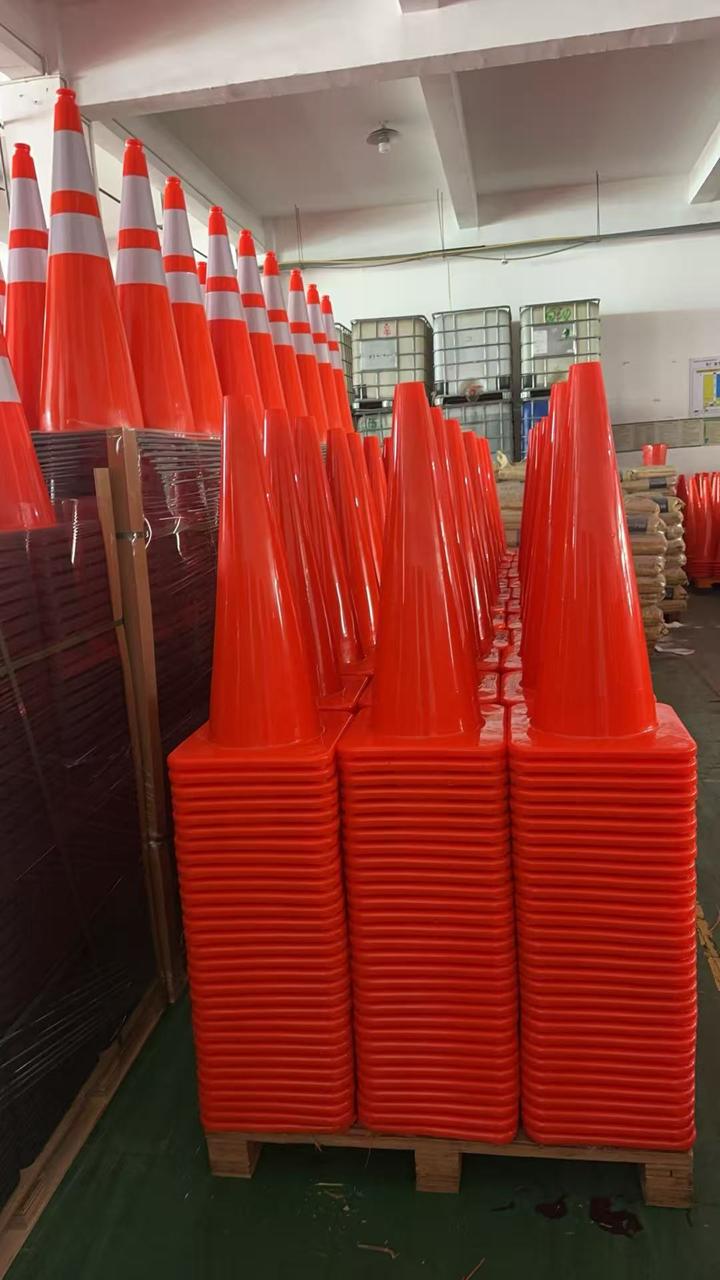
Traffic cones used in South America can face strong sunlight and prolonged heat. Standard flexible PVC may soften, lose dimensional stability, show plasticizer migration, or develop permanent deformation. For distributors, contractors and traffic safety project suppliers, the key question is whether a cone retains its shape, flexibility and recovery after prolonged exposure.
At Etonda, this calls for a combination of PVC formulation, UV stabilization, structural design and practical recovery testing.
Flexible PVC relies on plasticizers for softness and elasticity. A formulation designed for moderate temperatures may suffer excessive softening, reduced standing stability, surface oiling, permanent bending, slower recovery, color fading and loss of mechanical strength during outdoor use.
DINP is used in flexible PVC for its compatibility, relatively low volatility and durability. It can help improve long-term stability in outdoor applications.
Where heat resistance and low plasticizer loss are priorities, TOTM can be considered for its low volatility, low migration and aging performance.
Epoxidized soybean oil can serve as a secondary plasticizer and stabilizing component, supporting processing and thermal stability. There is no universal ratio: hardness, recovery, climate, cone weight and target life should determine the final formulation.
PVC may degrade during manufacturing and outdoor heat exposure. Calcium-zinc stabilizers, suitable processing stabilizers, antioxidants and heat-resistant additives can help preserve its appearance and mechanical properties. The compound should balance processing stability with long-term performance.
Strong ultraviolet radiation can accelerate color fading, cracking, loss of flexibility and reduced recovery. UV absorbers, light stabilizers, suitable pigments and weather-resistant additives should be considered in the material specification.
Traffic cones are repeatedly bent, compressed, dropped and sometimes run over. Impact and processing modifiers may improve toughness, but the formulation must balance heat resistance, flexibility, elastic recovery and outdoor durability. A cone that is too soft may lean in the sun; one that is too hard may crack or recover poorly after impact.
Reasonably uniform wall thickness helps reduce weak spots. The transition between the cone body and base should resist repeated bending and crushing.
A suitable base weight and geometry help the cone remain upright in vehicle airflow, wind and high temperatures. Select the design for the actual road application rather than weight or price alone.
Before mass production, define acceptance criteria for the customer’s operating environment. A practical evaluation may include:
Heat exposure at approximately 45–50°C for a defined period, checking for leaning, base deformation, surface oiling, softening and color change.
Compression or bending while the cone is hot, followed by assessment of shape recovery.
Recording initial recovery, recovery after several minutes and any permanent deformation after cooling.
Repeated bending or crushing cycles to simulate road use.
Recovery time should be agreed against project requirements rather than treated as a universal claim.
Brazilian projects may require compliance with ABNT NBR 15071. Verify the current standard and tender specification before production.
Confirm the latest project requirements for portable traffic-control devices, reflective sheeting type, cone height and performance.
IRAM 10032 covers traffic cones and other channelization devices. Importers should verify the latest version and specific tender requirements.
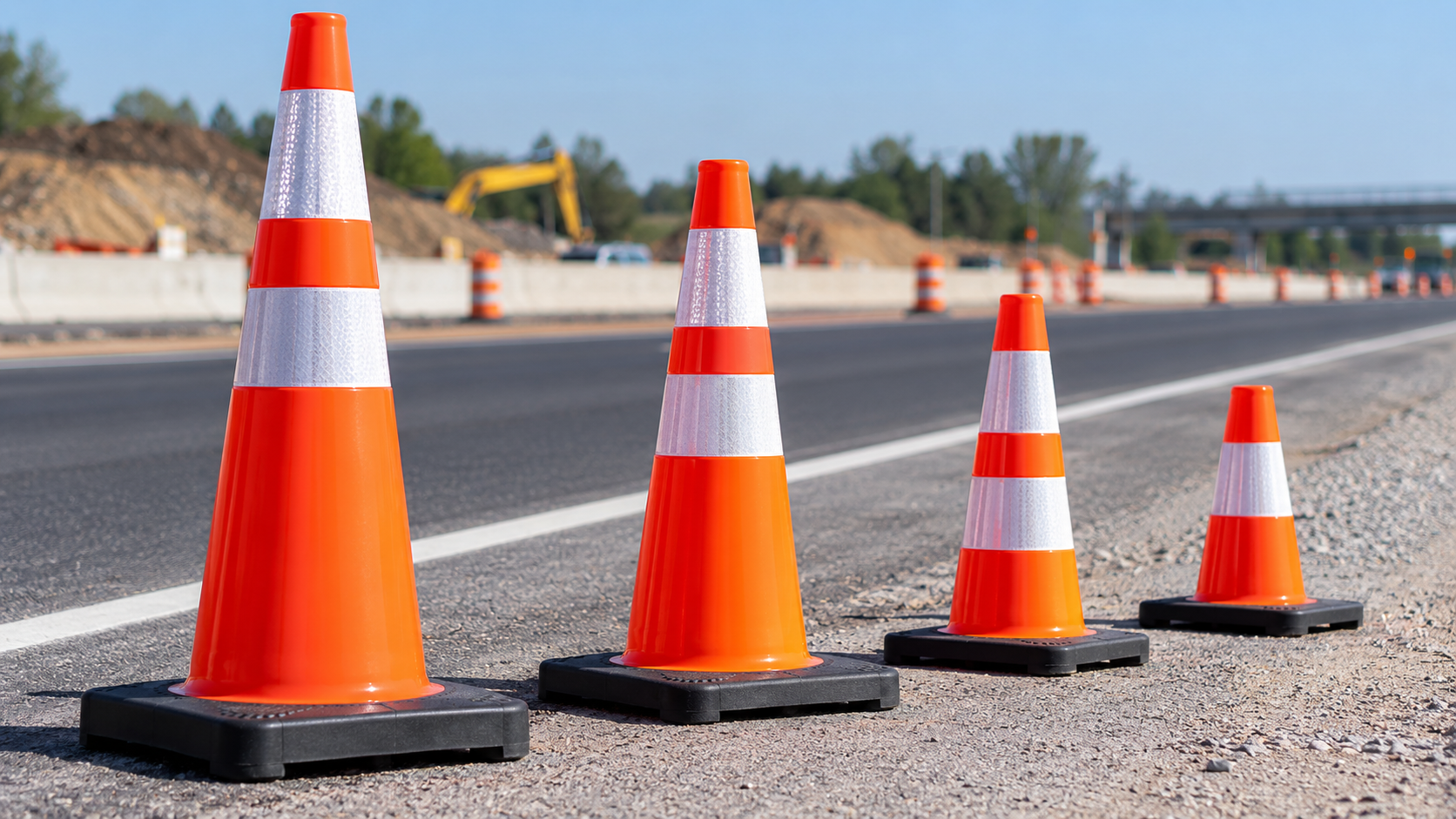
Projects can specify different grades, retroreflectivity, band widths, positions, heights and colors. Review the technical specification for each market rather than assuming one configuration fits every country. See Etonda’s Reflective PVC Traffic Cones for Road Safety and browse the full Traffic Cones category.
Confirm cone height, total weight, PVC hardness, operating temperature, heat deformation, compression recovery, UV and outdoor aging resistance, reflective sheeting, base material, applicable local standard, and OEM requirements. These details make supplier comparisons more meaningful.
A cone for a hot South American climate depends on the combined design of heat-resistant PVC, low-migration plasticizers, stabilization, UV protection, structure and recovery testing. Etonda can evaluate configurations for different climates, cone weights, reflective requirements and project specifications.
If you are importing traffic cones for Brazil, Colombia, Peru, Chile, Argentina or other Latin American markets, send us your required cone height, weight, operating temperature and applicable standard. Contact Etonda for product specifications, OEM options and sample testing.
CONTACT US
 Sales manager:Faye
 TEL: 008613182944931
 WhatsApp: 008618662728327
 EMAIL: info@etonda-trafficsafety.com
newsletter
follow us


